Trino Casino licence, trust and UK regulatory position
 Available in GB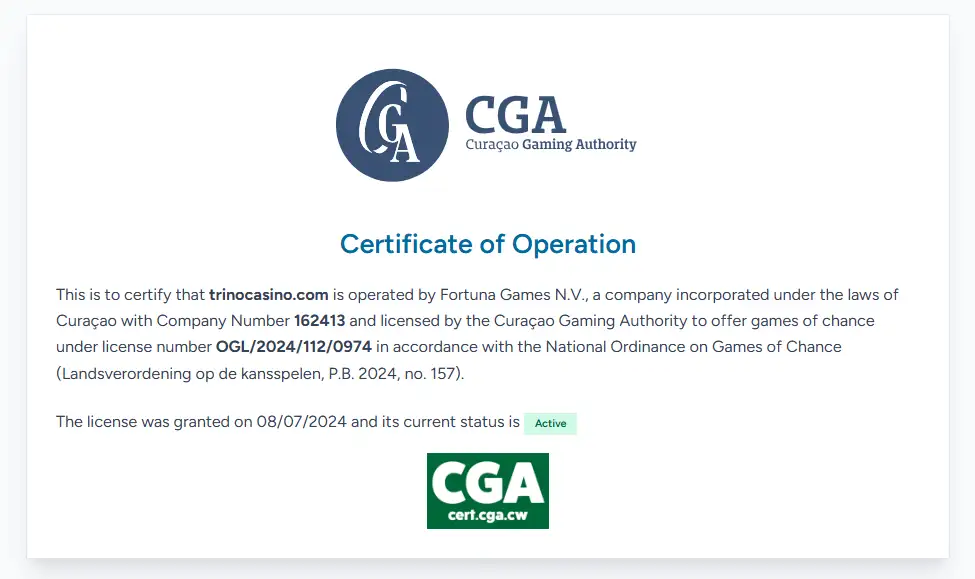
Licence and regulation guide – updated 28 September 2026
Trino Casino is operated by Fortuna Games N.V. and the Curaçao Gaming Authority certificate for trinocasino.com lists licence OGL/2024/112/0974 with status Active. The current UK Gambling Commission public business register does not list Trino Casino, trinocasino.com or Fortuna Games N.V. as a licensee. That distinction matters for players in England, Scotland and Wales because remote gambling operators serving consumers in Great Britain need an appropriate Gambling Commission licence. Northern Ireland has a separate gambling-law framework, so one UK-wide label would be misleading. The practical conclusion is specific: Trino has an active Curaçao licence; UKGC licensing and GAMSTOP participation require separate evidence.
Table of Contents
- The licence evidence in one view
- What the Curaçao Gaming Authority certificate verifies
- What the UK Gambling Commission register check found
- Great Britain: why the UKGC distinction is material
- Northern Ireland follows a separate gambling framework
- GAMSTOP scope and what it establishes
- How player reports and licence evidence serve different purposes
- Licence status and product facts remain separate
- Match each trust question to the source that can actually answer it
- A practical trust checklist for a UK player
- How Trino's Curaçao licence changes the UK regulatory picture
The licence evidence in one view
The regulatory position is clearest when three questions are kept separate: who operates the site, which regulator issued its licence, and whether the UK Gambling Commission register lists a Great Britain licence. Each question has its own record and jurisdictional scope.
| Question | Current position | Official reference |
|---|---|---|
| Who operates trinocasino.com? | Fortuna Games N.V. | Curaçao Gaming Authority certificate |
| Which licence is ? | Curaçao Gaming Authority licence OGL/2024/112/0974 | Curaçao Gaming Authority certificate |
| What is the licence status? | Active | Curaçao Gaming Authority certificate |
| Does the UKGC register list Trino? | No matching business-register entry appears for Trino Casino, trinocasino.com or Fortuna Games N.V. | Gambling Commission public register |
| What follows for GAMSTOP? | GB-licensed online operators must use GAMSTOP checks, but Trino should not be described as a GAMSTOP participant without UKGC licence evidence | GAMSTOP rule plus UKGC register result |
This evidence structure avoids two common mistakes. The first is treating a Curaçao licence as if it were a Gambling Commission licence. The second is treating the absence of a UKGC register hit as proof of a blanket legal or availability conclusion across the whole United Kingdom. Neither step is justified by the sources.
What the Curaçao Gaming Authority certificate verifies
The Curaçao Gaming Authority certificate is the strongest primary source for Trino’s operator and licence details. It identifies trinocasino.com as operated by Fortuna Games N.V., records company number 162413, and states that the company is licensed by the Curaçao Gaming Authority to offer games of chance under licence OGL/2024/112/0974. The certificate states that the licence status is Active.
Those details support a direct statement that Trino Casino operates under an active Curaçao licence. They do not establish a Gambling Commission licence, a British licence status, UKGC dispute coverage, or participation in a British self-exclusion scheme. Jurisdiction matters because each regulator’s licence has its own territorial and compliance scope.
You can inspect the current Curaçao Gaming Authority certificate directly. It provides the direct regulator record for the licence details shown here.
What the UK Gambling Commission register check found
The Gambling Commission public business register can be searched by business name, trading name and domain name. Checks for Trino Casino, trinocasino.com and Fortuna Games N.V. did not produce a matching Trino/Fortuna licence entry, and the alphabetical F-page of the business register contains no Fortuna Games N.V. entry.
The current UK Gambling Commission public business register does not list Trino Casino or Fortuna Games N.V. as a licensee. That finding applies to the Great Britain licensing register; wider questions about legality or availability depend on the relevant jurisdiction and should be treated separately.
Players can verify the Great Britain position through the Gambling Commission business register. The register provides the regulator’s current data for Great Britain licence checks.
Great Britain: why the UKGC distinction is material
For gambling regulation, Great Britain means England, Scotland and Wales. The Gambling Commission states that a business providing remote gambling facilities to consumers in Great Britain needs a Commission licence, including when the business is based abroad.
For a player in England, Scotland or Wales, the UKGC register result is a material decision point. The Curaçao record confirms an active Curaçao licence, while the UKGC public register does not list Trino or Fortuna Games N.V. as a Great Britain licensee. These records answer separate jurisdictional questions.
The Commission’s current remote gambling guidance is the primary source for the Great Britain licensing requirement. It is also why this site keeps licensing separate from product pages: a payment method, game category or support channel is a different factual question from local regulatory authorisation.
Northern Ireland follows a separate gambling framework
Northern Ireland has a separate gambling-law framework. The Department for Communities states that gambling there is regulated under the Betting, Gaming, Lotteries and Amusements (Northern Ireland) Order 1985 as amended by the 2022 Act. The department also records that the proposed second phase of reform was intended to address wider regulation of online gambling and gaming.
Gambling Commission remote-licensing rules are framed around consumers in Great Britain, while Northern Ireland follows its own statutory structure. The relevant part of the UK therefore determines which licensing and self-exclusion rules apply.
The Department for Communities’ Northern Ireland gambling-law overview is the appropriate primary source for that separation. Individual legal questions depend on a player’s circumstances and the applicable jurisdiction.
GAMSTOP scope and what it establishes
GAMSTOP states that all online gambling companies licensed in Great Britain must check its self-exclusion database when a user attempts to register or log in. That rule explains why GAMSTOP is strongly associated with Great Britain-licensed online gambling companies.
It does not create evidence that every casino accessible to a UK player is a GAMSTOP participant. For Trino, the current UKGC register does not list a Great Britain licence for Trino or Fortuna Games N.V.; GAMSTOP participation therefore requires separate confirmation. The responsible comparison is between the UKGC rule and Trino’s register position, not an assumption based on where a player happens to be located.
If self-exclusion coverage is a deciding factor, check the current scheme information before creating or using an account. The GAMSTOP explanation of how its online checks work is the primary reference for the participation rule described here.
How player reports and licence evidence serve different purposes
Player reviews and complaints can be useful, but they answer a different question from a regulator register. a group of comments about verification, withdrawals or customer support can tell you which themes are worth checking before depositing. An individual complaint cannot establish that a licence is active, that a payout policy applies to every account, or that a casino is safe or unsafe.
A better trust check uses layers. First, verify the operator and licence from a regulator source. Second, read the current terms and account instructions for transaction rules. Third, use player feedback to identify recurring friction points that deserve extra attention. Finally, document your own account status, payment method and support correspondence if a dispute develops.
Player reports can reflect different dates, countries, account states and payment methods. They add context, while the Curaçao certificate, the UKGC register and the live account terms answer the underlying regulatory and operational questions.
Licence status and product facts remain separate
Regulatory status and product capability should be checked independently. The absence of a UKGC register entry does not by itself prove that a reported game provider, payment category, support channel or mobile-browser feature is false. Each of those facts needs its own evidence.
That is why the bonus terms and regulatory scope focuses on promotion structure and avoids unsupported exact terms, while the payments and UK rules separates generally supported payment categories from methods visible to a particular account. The withdrawal verification treats fees, limits and processing times as separate changeable claims, and the account and KYC directs players to the current account prompt for document requests and timing.
Keeping those questions separate produces a more accurate picture than using licence jurisdiction as a shortcut for everything else. It also lets a player decide which issue matters most: regulatory coverage, game selection, cashier options, account verification or something else.
Match each trust question to the source that can actually answer it
Trust checks become weaker when one source is asked to prove more than it can. A regulator certificate can establish the licensed entity, licence number and current status shown on that certificate. A Great Britain public register can establish whether a matching Commission business record is present. Neither source can tell you whether a particular card, wallet or crypto option is visible in your cashier today, and neither can prove how quickly a specific withdrawal will be processed.
The same separation applies to terms and complaints. Current operator terms are the right place for account-specific conditions, promotion rules and transaction requirements when those details are available. Player experiences can add context about areas people found confusing or frustrating, while regulator records and operator terms serve different purposes. Keeping those source types separate gives each one the appropriate evidential weight.
| Decision question | Best evidence type | What not to substitute |
|---|---|---|
| Who holds the licence? | Regulator certificate or register | Third-party badge or user comment |
| Is there a Great Britain licence? | Gambling Commission business register | Curaçao certificate or casino marketing |
| Does GAMSTOP apply through GB licensing? | GAMSTOP participation rule plus UKGC licence evidence | Brand location claims or assumptions |
| What payment or withdrawal rule applies? | Current cashier and operator terms | Licence jurisdiction alone |
| Are complaints recurring around one issue? | Multiple dated player reports used as signals | A single complaint treated as proof |
For a UK player, this source hierarchy is more useful than a single trust score. It keeps the regulatory facts clear while leaving transaction and service questions to the evidence that governs them. It also makes changes easier to audit later: if a licence status, register entry or operator term changes, that specific layer can be rechecked without rewriting unrelated facts about the casino.
A practical trust checklist for a UK player
- Verify that the current Curaçao certificate still names trinocasino.com, Fortuna Games N.V. and an active licence.
- If you are in England, Scotland or Wales, check the Gambling Commission register rather than assuming a foreign licence is equivalent to a Great Britain licence.
- If GAMSTOP coverage matters to you, verify participation through the Great Britain licensing context instead of assuming every online casino uses the scheme.
- For Northern Ireland, use Northern Ireland-specific official sources rather than applying Great Britain wording automatically.
- Use complaints and player reviews as prompts for further checks, not as proof of regulatory status or transaction terms.
- Keep product questions separate: verify bonus conditions, payment availability, withdrawals and account checks on the pages and current interfaces that govern them.
For the broader product picture, return to the Trino Casino UK guide. Regulator evidence here establishes the operator and licence position separately from games, payments and promotions.
How Trino’s Curaçao licence changes the UK regulatory picture
The current Curaçao Gaming Authority certificate names Fortuna Games N.V., licence OGL/2024/112/0974 and Active status. For players in Great Britain, the separate UKGC check is equally important because the Gambling Commission public register does not list Trino or Fortuna Games N.V. as a licensee. That means the Curaçao licence should not be presented as UKGC coverage, and GAMSTOP participation should not be assumed. Northern Ireland needs its own legal context, while bonuses, payments, withdrawals and account verification still require their own evidence rather than being inferred from licence jurisdiction.